Playing real music by ear
Previously in this series, we've explored The basics of playing by ear, How to hear melodic patterns, and Recognising melodic intervals. Playing real music by ear is just a matter of bringing all of these skills together.
Introductory notes
One challenge of learning to play by ear on the ocarina is its limited range. There is a good chance that for any song you're listening to, at least some of the notes will be too high or too low to play, which can be confusing.
I'd recommend becoming comfortable with the basics of playing by ear, using performances that you know fit your instrument's range. If you have a music teacher, they can find and play you you songs in an appropriate key and range.
I have also compiled a collection of folk tunes that fit within the range of a single chamber ocarina, as well as software to transpose them to fit ocarinas in different keys. See A collection of folk music to play by ear on the ocarina.
With a solid foundation, it's pretty easy to progress to playing any music by ear using the following steps.
An introduction to scale equivalence
As we discussed in Octaves and scale formation, western music is based on a 12-tone 'chromatic' scale, from which we derive other scales, also called 'keys'. The thing is, when we are playing music by ear, the song we are listening to could be in any key!
Because the music we hear 'in the wild' can be in any key, we need to get comfortable playing in any key. That can be done by taking a simple melody and performing it in several keys.
Let's use part of a Welsh folk tune called Y Crwtyn Llwyd (The Grey Lad), first in C:
Then in D:
And in F:
In learning to play these melodies, you'll notice that they all sound like the same tune, despite being higher or lower in pitch. This idea is called 'scale equivalence'.
Now, with a basic familiarity with this concept, a good next step would be to take this tune and play it in every key that fits within the range. Starting on C, then C sharp, then D, and so on. We can do that as follows:
1: Learn the chromatic scale
The first step I'd advise taking is learn to play your ocarina's chromatic scale, becoming comfortable moving through all 12 notes per octave. It can be approached in the same way discussed in Learning the fingerings, but we include all of the sharp or flat notes.
I'm only showing some of the fingerings here because the best-tuned ones vary from ocarina to ocarina. It is best to find these from your ocarina's own fingering chart, or experiment with random fingerings and a chromatic tuner to find the best-tuned ones for your ocarina.
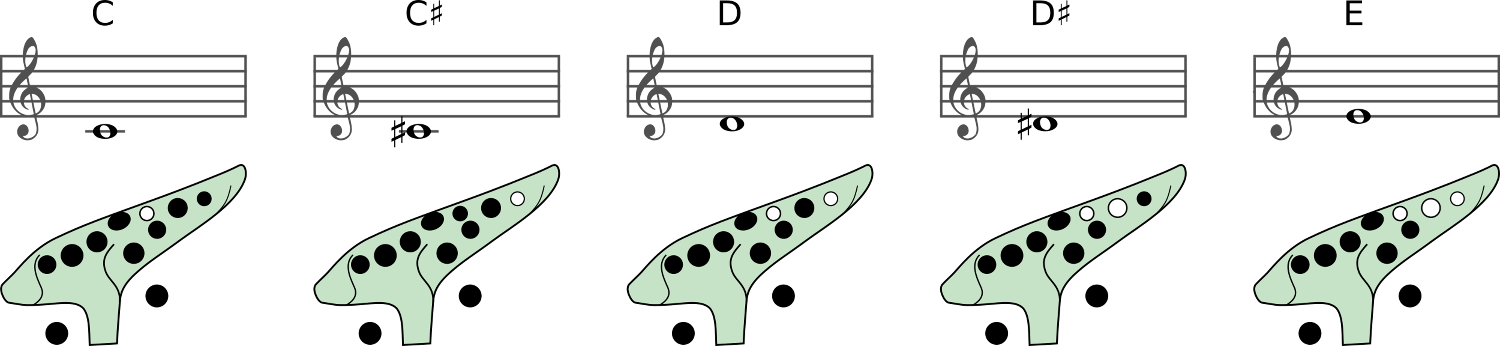
2: Learn the major scales
A scale is a linear sequence of pitches, but, with the exception of C major, they don't correspond to a linear sequence of fingerings. To move comfortably from one note to the next within a given scale, we need to practice it.
Say, for instance, you wanted to learn the C-sharp major scale. The required notes can be easily found online, and you'll already know the fingerings from learning the chromatic scale.
Loop through all of the fingerings regularly up and down the scale, and it'll become automatic. Break the scale down into chunks, as previously mentioned, if needed.
3: Play the tune in that scale
We can determine how the notes of one scale relate to those of another using scale degrees. You start on the lowest note of the scale and walk up the scale, numbering the notes. For instance, in C major:

When we played it in C, the first note of the tune was an F, the fourth note of the scale. We can find the equivalent note in C sharp by counting upwards from the tonic of the scale, finding the fourth note:

Having developed a good muscle memory for the scale, it should then be pretty easy to work out the rest of the tune by ear.
Recognising different types of scale
You may have run across terms like 'G Major', 'D Minor', or 'C Dorian', which are names for keys:
- The first part (for example 'G') names the root note of the key, as we have discussed.
- The second part names the notes that you will find in that key, as well as its characteristics. For example, major keys are often said to sound 'happy'.
Different types of scale are built from different sequences of intervals. For example, here are the differences between C major and C minor:


We also need to learn to recognise these different scale types, and I'd recommend starting out by learning to differentiate some simple patterns by ear, such as:
- 'whole, whole, half'
- 'whole, half, whole'
Learn to play these two scale fragments on your instrument, perhaps from C at first. Ask someone to play them randomly, and perform the appropriate one. You may also find it helpful to learn to sing the required intervals.
As you get better, then expand out to:
- Recognising the scale patterns starting from different tonic notes.
- Recognising and playing the whole scale.
- Recognising the scale type from a more random sequence of notes, more akin to real music.
Finally, introduce other scales, such as melodic minor, harmonic minor, and modes.
Breaking a song into short sections and slowing it down
Listening to music, there's a good chance you'll find it overwhelming, with notes passing so fast that you can't hear them and too many of them to memorise.
Those two issues can be addressed if we:
- Slow down the recording.
- Break it down into smaller parts.
They can be learned one at a time, then played together. We can approach that in a few ways:
- Learning from a recording: Breaking up a melody can be done easily with an audio editor. These tools can loop small parts of recordings and slow them down without changing the pitch. Such tools include Audacity (free) or Reaper (paid).
- Learning with a teacher: You can ask them to play a melody in short sections for you.
And with regard to where to split the melody, the idea is to follow the phrasing. For example, if you consider the following melody:
It can be broken down as follows:
Depending on how good your short-term memory is, you may find it easier to learn longer or shorter parts; just do whatever works for you.
Playing a melody by ear
The first thing I'd recommend doing to play your first 'real music' by ear is to find the key, so you know which notes it uses. For instance, if the song you're learning is a popular track, you can usually find its key by searching 'key of [song name]'.
In case that doesn't work, it's usually possible to find the key by finding the pitch of the final note in the melody. This trick works because most music is tonal: it's a 'journey' through a series of pitches that resolves to the tonic note.
Finding the first note
The first note will generally need to be found by trial and error, as was introduced in How to play the ocarina by ear:
- You listen to the music and hold the pitch of the note you want to find in your mind.
- Play any note on your instrument, listen to see if it is higher or lower than the note in your mind, and raise and lower your pitch until you find it.
You could find that the note is too low, or too high to play on your instrument, in which case it can be found in a different octave. How to do so can be learned as follows:
- Start by learning how to sing two notes an octave apart.
- Play a note on another instrument, then play it on your ocarina an octave higher to learn how this sounds. Having an assistant helps with this.
- Finally, ask someone to play random notes and find them on your ocarina in a different octave.
And finding the rest
Now the general idea is to listen through each part of the melody and hear its structure using the techniques we've been working on:
- Listen through a section and hear if each subsequent note is the same, higher, or lower than the previous one.
- Try to identify the intervals and create a map of the structure in your mind or on paper, just like we did in the first part of this series.
What to do when the range doesn't fit
While working through a melody, there's a good chance that at least some of the notes do not fit within the range of your ocarina. There are a few options:
- Use an ocarina in a different key to cover the required range.
- Work out the melody on an instrument with a larger range, then adapt it to the ocarina afterwards. A keyboard can work well for this.
- Transpose the music by ear. As we explored, music can be played in different keys. It can be transposed by ear if the observed intervals are performed in a different scale.
Congratulations
With a bit of patience and trial and error, you'll find the notes of one section and then the next of the broken-down melody. Soon, you'll have learned your first 'real' music by ear. Congratulations.
