Finding music to play on the ocarina
As of the time of writing, very little music has been composed specifically for the ocarina. However, there is still a huge wealth of music available to play, including:
- Vocal music: The untrained human voice has a similar range to a single-chambered ocarina, and most vocal music can be adapted pretty easily.
- Bagpipe music: Like ocarinas, bagpipes as an instrument family have a small range, and most of this music can be easily adapted to the ocarina. This includes music for the highland bagpipe, the Swedish sackpipa, and the French cornemuse du centre.
- Music for other limited range instruments: For instance, all music published for the 4-hole harmonica can be played on the ocarina, and Pat Missin's 'The Ultimate Miniature Harmonica Tunebook' would be a great resource for beginners.
- Original compositions: There are a small number of original compositions for the ocarina, which mostly come from the Italian ocarina septet tradition. They can be found online.
- Music arranged for ocarina: There is an increasing number of arrangements available for ocarina ensembles and solo performers, which can also be found online.
As fully chromatic instruments, ocarinas do offer the possibility of playing music that modulates between musical modes as long as it fits within the instrument's range. Their unstable pitch also opens up many options for the performance of microtonal music.
However, because of their limited range, ocarinas do not work like other instruments, where one can play everything with a single instrument. Rather, one must use multiple ocarinas in different keys to cover the required range of notes for a given song.
The note ranges covered by different ocarinas are addressed in the article Ocarina keys and pitch ranges. For instance, a 10 hole single-chamber alto C ocarina can play from about C5 to F6.

It is also worth noting that the timbre (tone colour) and volume dynamics between the high and low notes vary hugely from one ocarina to another. What is desirable will depend on the music you are playing.
These factors are set when the ocarina is made and can not be changed. See Ocarina playing characteristics and timbre for guidance.
How music for the ocarina is notated
Music for the ocarina is usually written in standard music notation using the treble clef.
On single-chambered ocarinas, notes in different octaves are normally just called 'high' or 'low', for example, 'high C' and 'low C'. Every note from the low C until the B above is called 'low', while the second C to the second F are called 'high'.
On the ocarina, the first ledger line C on the staff is usually considered to be 'low C', regardless of the instrument's absolute pitch range:
- An alto (tenor) C sounds an octave higher than written, and a soprano C sounds 2 octaves higher.
- A bass C ocarina sounds at written pitch, and a contrabass sounds an octave lower than written.
- Multichamber ocarinas follow the same convention. On multichambers that sound more than two octaves, notes may be named using scientific octave numbers, such as 'C4, C5, C6', to avoid ambiguity.
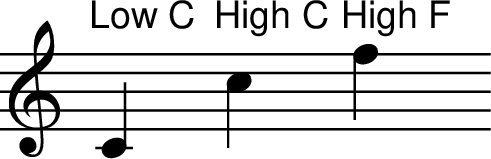
Ocarinas that are in keys besides C may be handled in one of two ways:
- By reading music at written pitch: For example, if an ocarina is in G, the low G would be written as the second line from the bottom of the staff.
- By treating the ocarina as a transposing instrument: In this case, if an ocarina is in G, the low G would be written as C, 'as if' the ocarina were in C.
Ocarina ensemble music commonly treats non-C ocarinas as transposing instruments. All music is typically notated as-if for a C ocarina, between the first ledger line C and top line F in treble clef. Music for bass and contrabass ocarinas are also notated as such.
Outside the context of ensemble music, learning to read music at written pitch on ocarinas in different keys is very valuable, allowing you to play any music you encounter without needing to first transpose it into the range of a C ocarina.
