Ocarina articulation and ornamentation applied
I think that the best way of learning how to make use of articulations and ornaments in your playing is through example. We start with a simple song melody with no articulation and build upon it.
Articulation and phrasing in songs
Let's look at some ways to use articulations in songs, using 'The Foggy Dew', a ballad about the Irish Easter Uprising. It has six verses sung over the following base melody.

And here it is again with the lyrics of the first verse. As we will see shortly, considering the structure of the lyrics is very helpful, even when making an instrumental performance. Notice that the repeat has gone away and the melody changes in other ways to fit the words.

When we play music, we don't just want to play one note after another. Like we do in speech, we vary our timing and spacing to communicate the desired intent.
Having the lyrics, it's easy to get a basic idea of how to phrase something because the phrases align with where you'd put a full stop or a comma. I've indicated these with slur marks.

As you can see here, the phrases do not align with the bar lines, and they don't have to. Bar lines just mark fixed periods of time and don't imply the structure of the music.
When a melody has a pickup note (anacrusis), it often shifts the phrasing in relation to the bar lines. In this case, the end of the phrase is a quarter note before the end of the bar.
Basic articulation
When we read or sing, we naturally pace our delivery and take breaks between sentences; it's important that we do the same when playing instrumental music.
- A good starting point is to begin each phrase tonguing the first note, then slur the remaining notes in the phrase. If there are any notes of the same pitch, separate them by tonguing them, but make this articulation shorter and softer, closer to a 'd' than 't'.
- Tongue the notes during the phrase using a brief articulation, and tongue the spaces between phrases using a longer gap, letting the tongue linger for longer.
In the following, the slur marks again denote phrases, and rests indicate the longer stop added to separate them. Have a go at playing them using the two approaches suggested.
Regardless of whether you're slurring or tonguing the notes within a phrase, still try to play each phrase as a single breath and breathe between phrases.

Another thing you may want to try when tonguing most of the notes is slurring where a word is split across two or more notes:

This is a good baseline, but it can still sound a bit dry and mechanical because human performances include details, such as subtle changes in the rhythm, that are difficult to transcribe. That's why listening to or playing over performances is important; it helps you learn the 'unspoken bits'.
However, I wouldn't reference The Chieftains' performance with Sinéad O'Connor for basic phrasing, as it's unusual, the performance style varying between a ballad and a slow air. I have a note on this towards the end of the article.
Using fingered articulations
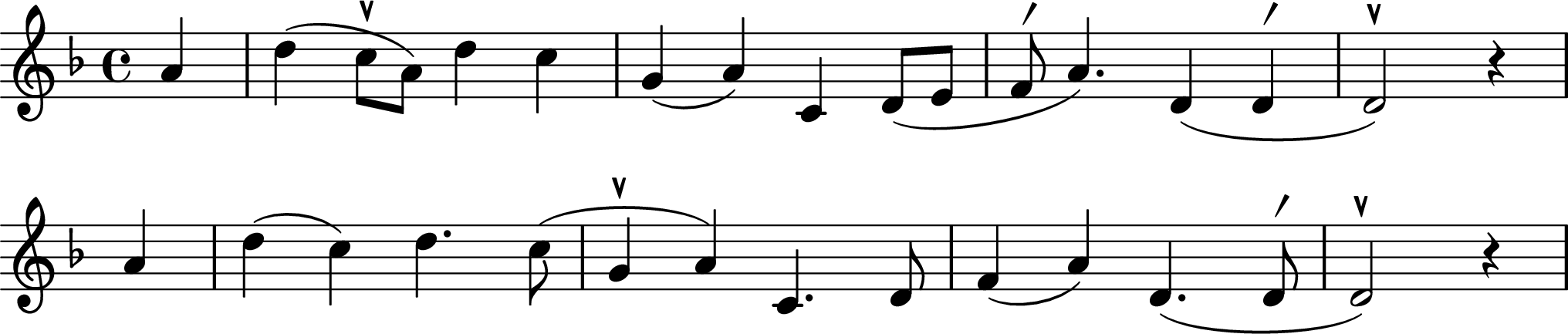
On the ocarina, you can also make use of fingered articulations such as cuts and strikes. Basically, you can substitute them for any tongued articulation by slurring those two notes and separating them with a cut or strike.
Playing style can vary between being mostly tongued using slurs for ornamentation, to mostly slurred using fingered articulations and tonguing for ornamentation. Experiment to see what you like the sound of.
Slides and emphasis
The general idea in creating emphasis on the ocarina is to do something that sounds different. One option is to slide into a note—either using a finger slide or breath slide.
These articulations are particularly emphatic when making an ascending leap. As the ocarina's high notes are naturally louder, they carry their own emphasis, and the slide amplifies the effect.
I've added a few slides and would suggest performing them as finger slides. If you like, try sliding into some notes with the breath as well.

Emphasis using trills, mordents, and turns
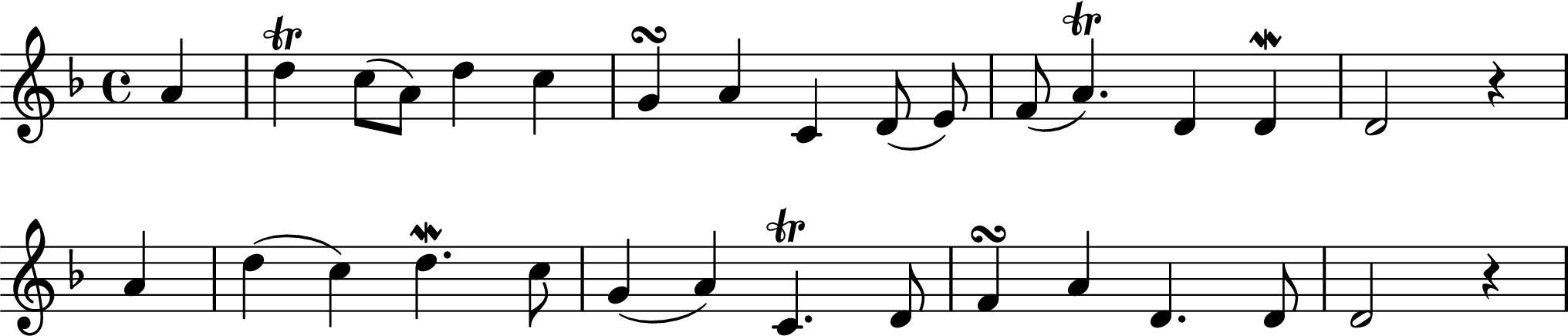
Another way that you can create emphasis is to trill the note, play a mordent, or a turn. I've added a few examples of where you could possibly use these in the following.
I've indicated a generic mordent. Feel free to try upper and lower mordents and see what you like the sound of.
Emphasis using fingered articulations
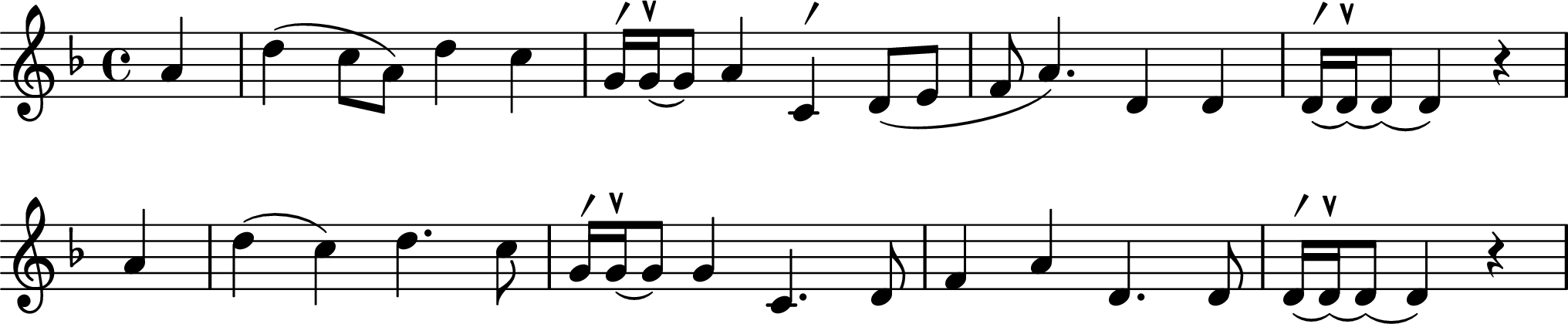
Fingered articulations can also be used to create emphasis in a few ways:
- Using a single cut or strike at the start of a note can be an effective emphasis by itself in some contexts.
- The effect of that can be amplified by tonguing the cut or strike, starting the airflow mid articulation, adding a chirp to the attack of a note.
- Starting a note with multiple fingered articulations in rapid succession. It would be a good idea to practice these slowly, and feel free to omit them at first.
Varying phrasing
'The foggy dew' has been performed by many artists, with just as many variations. The Chieftains performance with Sinéad O'Connor, available on YouTube at the time of writing, is particularly interesting for its mix of styles.
This performance begins as a free-time air, morphs into a march or ballad, and then ends in a style similar to the opening. The way the melody is phrased varies significantly between these sections.
The first part of that performance is phrased approximately as follows. Slurs are used to denote phrases. If you've never seen it before, the half circle with a dot is a fermata; it means that the note is held longer than the rhythm implies, at the performer's discretion.
This arrangement works in the context of a sung slow air. I'm not sure how effective it would be as an instrumental to an audience who doesn't know the lyrics.

Phrasing in traditional dance tunes
I believe that traditional dance tunes make a good contrast, as they are phrased differently from most songs. This music exists to carry a dependable rhythm for dancing, and as such, the phrases are almost perfectly uniform.
Typically, these tunes are formed from two eight-bar parts, called 'A' and 'B', each of which is formed from four two-bar phrases. I've marked the phrases with slurs below.
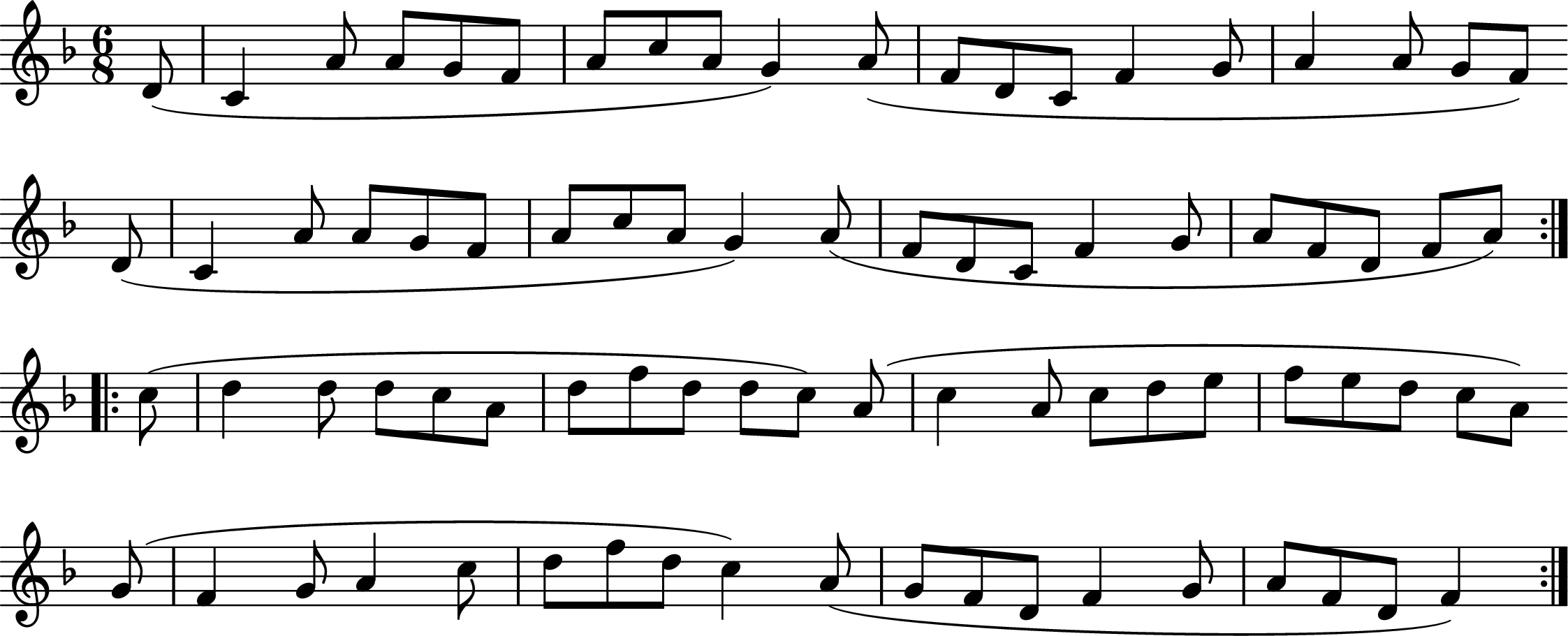
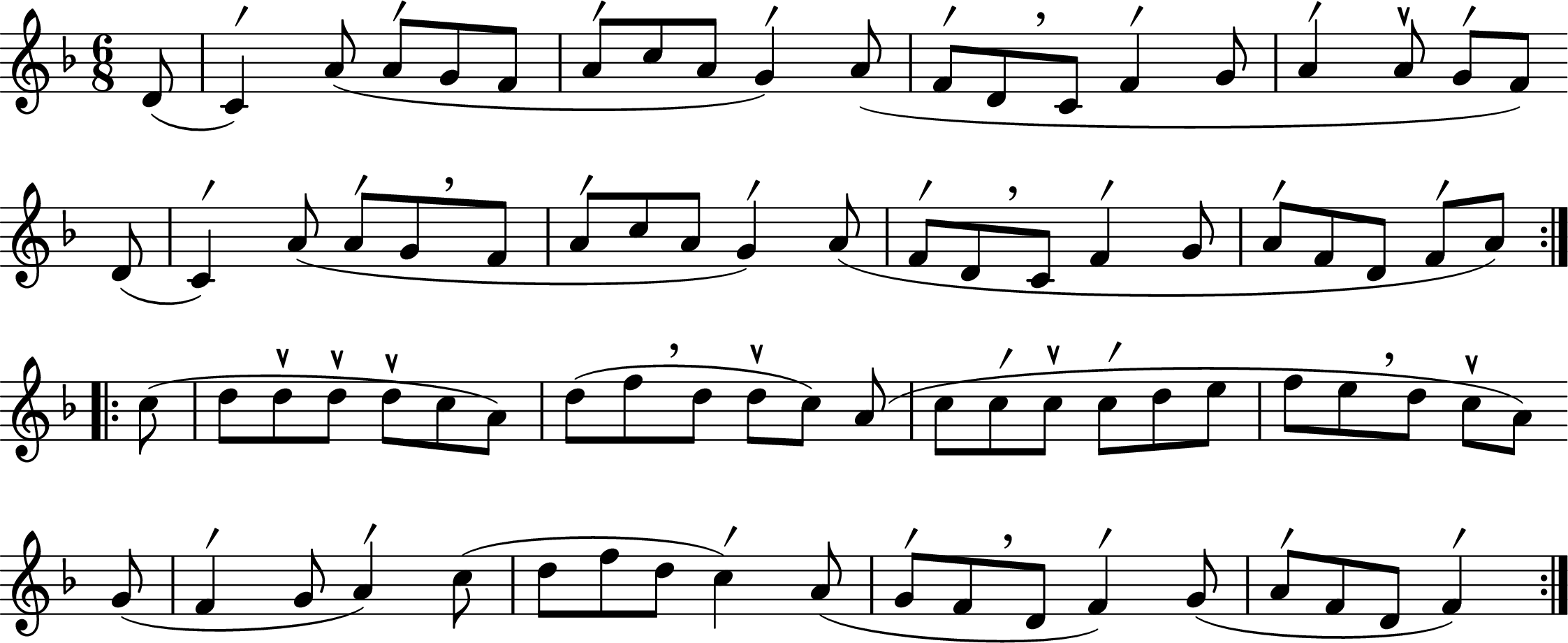
Everything mentioned for songs applies equally to these tunes, except that trills are rarely used. The following score is the tune written out with slurs and fingered articulations. Rolls are written out in full.
Note that the curly commas are breath marks and indicate where a note could be shortened or dropped to take a breath; they are not mandatory.
Also, in this setting of the tune, many of the fingered articulations mark the pulse of the music, and it's also possible to pulse the breath in time with these if you wish.
Final notes
Hopefully, these examples have given you some ideas about how to use articulation and ornaments in your playing. Beyond these basics, I'd suggest seeking performance-style guidance for the music genres you're interested in playing, as well as critically listening to and copying performances by different musicians.
