Modifying music to fit the ocarina's range
Sooner or later, you'll want to play some music that doesn't fit within the ocarina's limited range. While multichamber ocarinas are an option, it is sometimes possible to modify the music to fit.
This technique, sometimes called 'folding', involves changing some notes to reduce the needed sounding range while retaining the original character.
Many of the following examples are from tunes that I've played as a 'set', one running directly into another. I modified them to avoid changing instruments, but they could be played on ocarinas in other keys. Also note that many of my examples are incomplete tunes; I've included only the parts necessary to illustrate the concept of folding.
Shifting a note by an octave
It's very common to run across tunes with a single low note—generally B, A, or G—often appearing at the beginning. Consider the next tune. While this part could be played on an 11-hole C ocarina, the second part of the tune (not shown) goes up to G. It can be brought within the range of a D ocarina by simply playing the opening B note an octave higher than normal. This is shown after the original.
Morfa'r Frenhines (The Queen’s Marsh)

Morfa'r Frenhines (folded version)

'Ode to Joy' is another good example. The low G appears only once and can be replaced easily—often with a high G. Of course, playing it on a G ocarina is better, but substitution produces a satisfactory result.
Shifting a whole phrase by an octave
In some cases, an entire musical phrase can be raised or lowered by one octave. Take 'Merch Megan', for instance:
Merch Megan (Megan’s Daughter)

The first part of this tune ranges from D to high E, so it easily fits on either a C or D ocarina. As written, the second part up to D.C. (da capo, meaning 'play from the top') is unplayable because it reaches up to high B.
As the section never descends below high D, it can be shifted down an octave as shown to bring it into range. And as this section is a complete musical phrase, the transition doesn't sound jarring.
This simple fold sounds fine to my ear when played by itself. It'll also work perfectly well with the original tune in a group
Merch Megan - folded version

Eliminating leading tones
You will frequently encounter tunes that end on a leading tone, the semitone below the tonic. For example:

How could this be handled on a 10-hole ocarina? In the theme of the previous section, both the leading tone and the final tonic can be moved up by one octave. This reduces the range yet retains the same musical feel. Variations like this are common practice on any instrument. When a tune is played multiple times, it's an easy way of breaking monotony.

Another option is to play a different note as a harmony. A lot of the time, you can substitute the leading tone for the second of the scale. In this instance, swap B with D. This works because the previous notes usually lead down towards the tonic. Depending on the tune, you may be left with a straight rundown as shown or a repeated note—two D's before C in the key of C. Both are fine.

Not all notes are equally important
Some notes of a tune are more important than others. The following tune, 'Hummingbird' by Jamie Smith, is a perfect example of this. As the whole tune is quite long, I've only shown the B part:
Hummingbird - B part

This could be approached in two ways. You could play it on a D ocarina and attempt to alter the high A and B. Alternatively, you could play it on a G ocarina and alter the low end. In this instance, the second of these options is superior, since the phrase with the high A and B is important to the tune's overall feel. The low E in the final bar is much less so, but what can it be replaced with?
The note can be replaced with a rest, which is the safest option when playing with others. You could also replace it with a long G note or a rundown. These options are shown below.

Playing a harmony
The melody of a tune is almost always written around an underlying chordal sequence. Knowing these chords is a great help when adapting a tune. Say you wanted to get rid of the low B♭ in the following tune:
Gwenynen Gwent (The Bee of Gwent) - A part

The offending note is in bar 3. If you look above the line you'll see the letters 'B♭' for the chord of B♭ Major. A quick web search will reveal that this chord contains the notes B♭, D and F.
The out-of-range note can be swapped for any one of these, including B♭ an octave higher. Experiment to see what works best for a given tune. For this one, I think replacing the low B♭ with F sounds best.
Gwenynen Gwent - A part - folded version
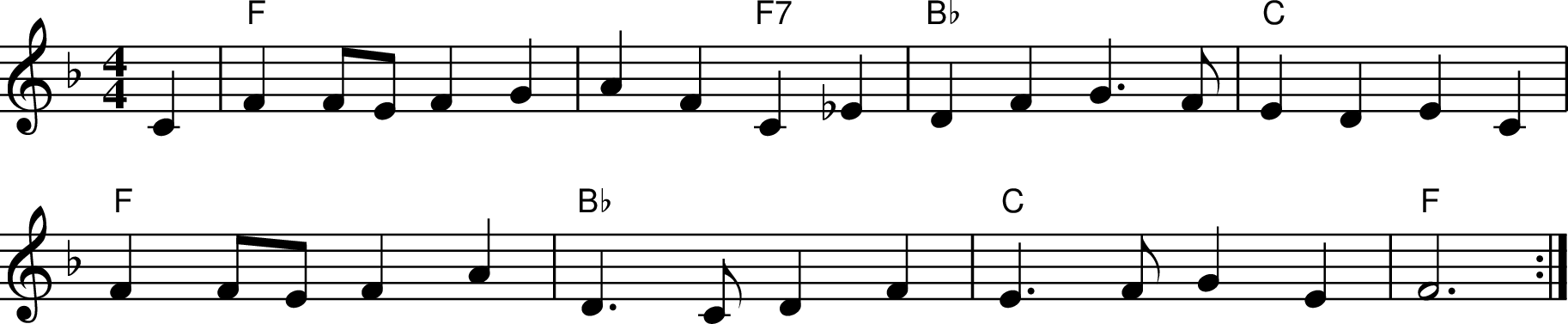
You're going to run into cases where the out-of-range note doesn't fall into the chord, as in this example. These are called passing tones. In these cases, I recommended looking at the structure of the melody and trying a few notes. You'll find something that sounds alright
How well modifications are received by an audience depends on how well they know the original tune and how confidently you play. Trust your ear when you make any variation; if it doesn't sound right, try something else.
When single notes do matter
There are instances where a single out-of-range note is more important than it first appears, e.g., the lone high A in 'Cooley's Reel'. This high A matters both because of the ascending note run leading up to it and because it falls on a strong beat. The whole previous section builds an expectation that you'll hear the high note, which leads to despair when it's absent. Because of this, I don't think this tune can be faithfully adapted.
Cooley's

On the whole, it tends to be easier to change low notes than high notes without affecting the music.
What to do when you cannot adapt a tune
Sometimes, it's impossible to adapt a tune. If you're playing alone, I recommend using a multichamber ocarina, a different instrument with a wider range. Or find a different tune; the world isn't short of them.
When you're playing with a group of mixed instruments, you may be able to play a harmony instead. Bass ocarinas tend to work best for this since they can blend into the background. I'd be cautious of playing harmony on an alto-range ocarina and would never do so on a soprano. If a harmony obscures the lead melody, it can spoil the sound of the entire group.
Other applications of folding
Folding can also be an effective way of creating melodic variation, such as to play something differently on repeats. You can find examples of this within Irish and Scottish traditional music.
Irish and Scottish folk bands also frequently utilise harmony playing in a similar way. These groups consist of various instruments like fiddle, accordion, flute and tin whistle. They play tunes like 'Cooley's Reel'.
The first time a tune is played, one instrument takes the lead while the others play long notes in harmony; the lead rotates among players throughout the performance, and they often play as one to finish. Such creates a progression in the performance.
