An introduction to kinaesthetic sheet music reading on the ocarina
What do you see if you look at the heads of the following notes (the black circles) as a group? Imagine each note like a point on a graph, and draw a line between them in your mind's eye. What shape do they draw?
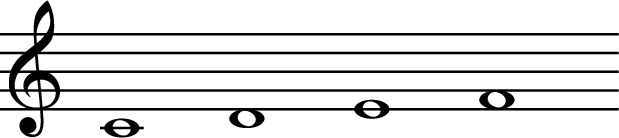
You may notice that the group as a whole forms a smooth ascending line, each sequential note moving up by one position on the staff. Such a pattern is called a 'scale run'.
These patterns taken together correspond to an equivalent pattern of fingerings on your instrument. This is the same sequence as shown in the notation above:
The goal of kinaesthetic pitch reading is to be able to look at some notation, and instinctually know how to perform it on the ocarina. Developing that skill is a two-step process:
- First, you practice a short pattern of notes repeatedly until performing it becomes muscle memory.
- Once you can play them, this muscle memory is associated with the equivalent pattern in notation.
If you then repeat this process for hundreds of different short fingering patterns, they become like building blocks your subconscious will piece together, allowing you to play music effortlessly, without all of the logical analysis of traditional teaching approaches.
You can practice this using the collection of figures below. To practice them:
- Begin by watching the fingering demonstration and learn to perform each of the figures on your instrument.
- Once you can perform the figure, do so while looking at the same figure in notation, and your subconscious will start to connect the visual pattern to the muscle memory .
All 3 note figures in C major using seconds and thirds
Here are all of the figures possible using seconds and thirds, up to a length of 3 notes, within the range of a 10 hole C ocarina.