I have the belief that as long as the sound throughout the range of the ocarina is not hindered by the existence of subholes, it's a good idea to have them (2 specifically) as they primarily extend the range of the ocarina on the low range - and allow for more alternate fingerings.
However, I've seen arguments that they constrict the angle of play (forcing the angle of your middle (and index finger)) and that their added range is not really useful in a lot of repertoire which is more suited for the ocarina.
I concur with the fact that subholes would require the row of holes for both hands to be further spaced apart thus limiting the possibilities for a more ergonomic finger placements on a given ocarina body. But a lot of 10/11 holes that I have seen seem to have ample room to include a subhole/s (but are not included due to other reasons). A separate discussion could be made for multichambers as weight is much more important to ensure faster chamber switching (but angle is inherently forced by the angle of the 2nd/3rd chambers, so is would it be suitable to have a right hand subhole on those?).
Happy to see discussion for both sides, for both singles/multis and for different intended repertoire.
With respect to the question about ergonomics, having subholes limits you because:
- They force you to hold your hands at an angle dictated by the placement of the subholes. Different people's hands are different and, for some people, the angle that their hand may naturally lie at does not match the angle dictated by the placement of the subholes. Covering the subholes thus forces them to adopt a uncomfortable, or even painful hand posture.
- It can be ergonomically useful to allow one or more fingers to overhang a hole. For example If one finger is notably longer than the fingers besides it. This is not possible with subholes if the overhang would result in the subhole being covered.
With regards to sound quality, subholes will always change how the instrument sounds and its playing characteristics due to the physics of the instrument. The whole chamber is oscillating when an ocarina is being played. The pitch depends on the total area of the finger holes, and every note depends on every note below it. While adding a subhole may seen insubstantial due to the small size of the hole, it actually substantially increases the size of every other hole on the instrument, because hole size scales exponentially..
For single chambered ocarinas, having subholes almost always (except in exceptionally well made instruments) makes the whole instrument sound worse. This manifests in the form of making the high notes sound airy, and or requiring a huge breath cut for the subhole note to sound in tune.
Any ocarina that is being manufactured today would sound different if one or both subholes were removed and the internal chamber volume scaled down. Many ocarinas would sound much cleaner and more uniform in timbre over their range if this were done.
Yes, subholes can have advantages in allowing some other alternate fingerings, but for me the cons greatly outweigh the pros. Substantial irregularity in timbre would not be acceptable in any other instrument family - if you were to buy a recorder or tin whistle where the highest A and B sound way more airy than any other note, it would be considered defective. Ocarinas should be held to the same standard.
The effect of subholes can also be achieved without the downsides, by playing a multichamber ocarina in a lower key. For example a double or triple alto G ocarina can play the low A, B, and also G, with no sacrifice in sound volume, or quality over the instrument's range.
It is also possible to have subholes on a multichambered ocarina without this having such a strong negative effect on sound quality, because each individual chamber produces a smaller 'slice' of the instrument's total range. The other negative effects regarding ergonomics still apply though.
Edited 09-Jul-2026 12:08 PM by Robert.
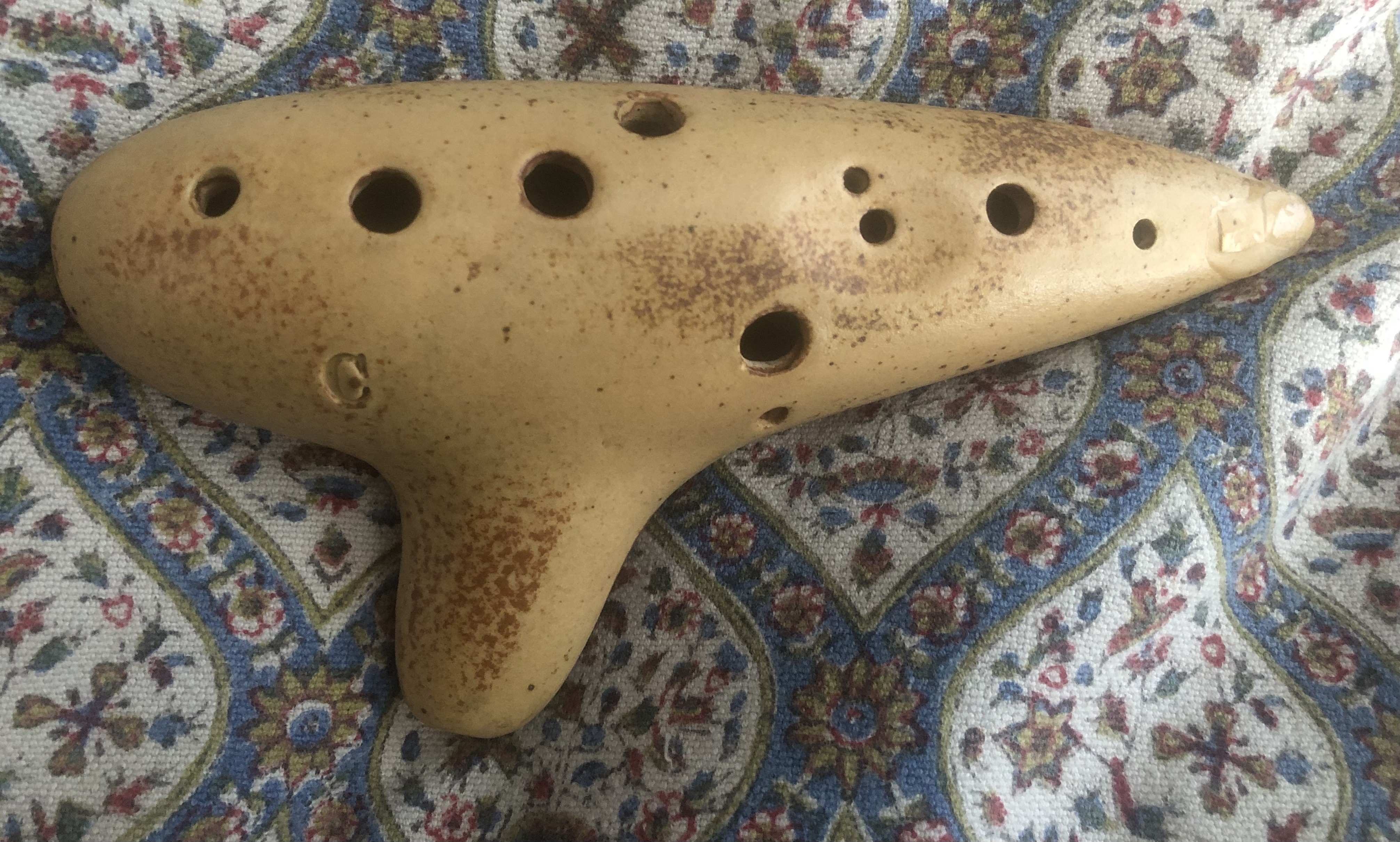
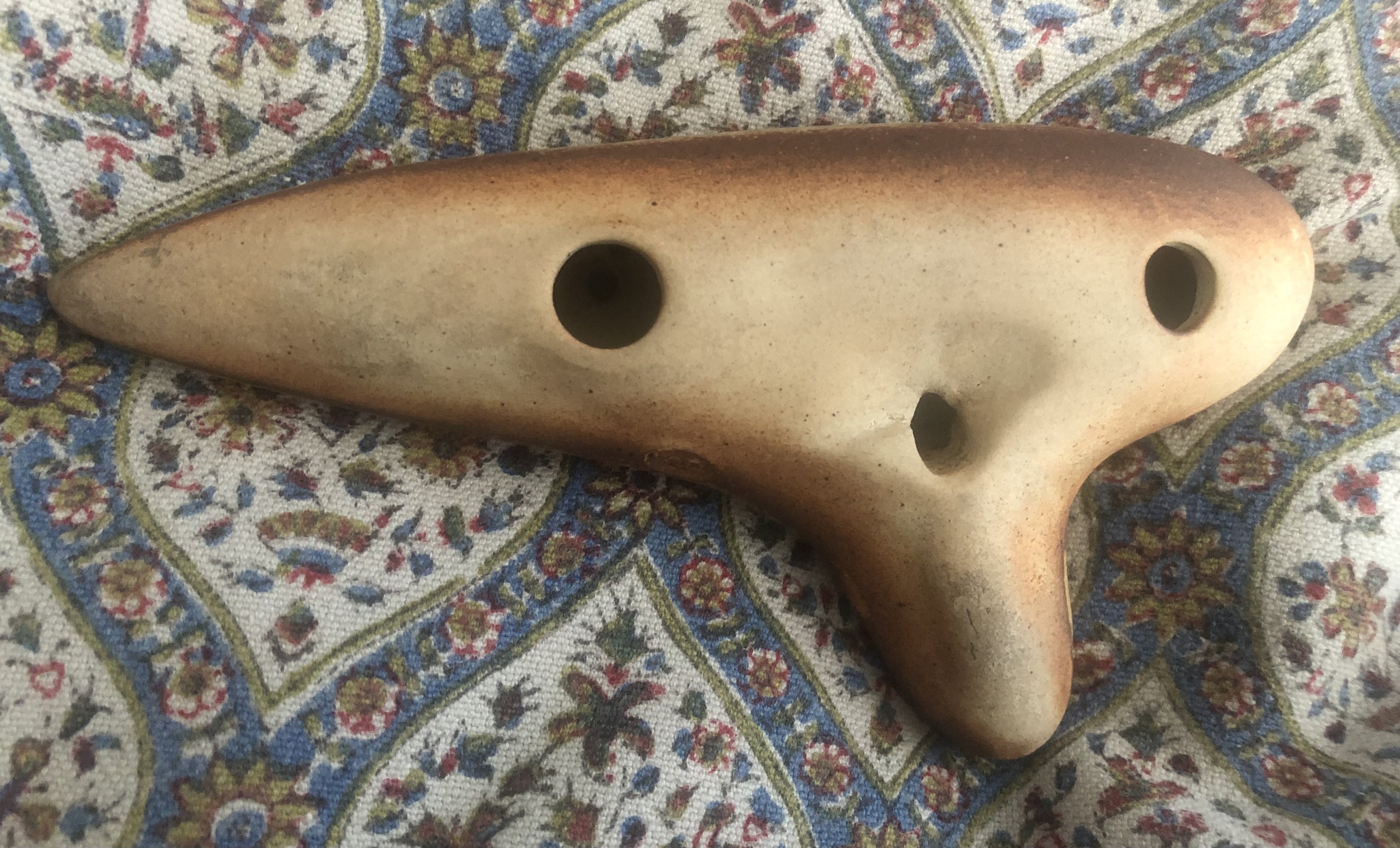
Here's an 11-hole that illustrates the problem. It's an old Japanese "Jun" ocarina I got from Adam Horitsuru. It sounds great, up there with my Rotter Emiliano. But that subhole is entirely pointless. Yes you can get a low B - but it's much more musically useful to just blow a bit harder and get all the lowest notes sounding stronger. Trying to not cover the subhole is insanely difficult. I just treat it as one hole, both or nothing.
And maybes mean nothing. If you think this extended range of feeble notes is useful, give a precise example, with a score, that shows why. I've asked on other forums often and the answers are usually:
- There's got to be one but I can't point to it
- I've used the wrong pitch of ocarina or the wrong transposition
- I'm worrying about upbeats that don't have to be at the specific pitch they're written
Edited 07-Jul-2026 04:47 PM by Robert.
Quote:
- There's got to be one but I can't point to it
- I've used the wrong pitch of ocarina or the wrong transposition
- I'm worrying about upbeats that don't have to be at the specific pitch they're written
It would be helpful to elaborate on these points because the context that they are referencing is probably not obvious. The point about upbeats for example I understand, but would be easier for others to understand if examples were given.
Edited 09-Jul-2026 12:08 PM by Robert.
Quote:
Quote:
- There's got to be one but I can't point to it
- I've used the wrong pitch of ocarina or the wrong transposition
- I'm worrying about upbeats that don't have to be at the specific pitch they're written
It would be helpful to elaborate on these points because the context that they are referencing is probably not obvious. The point about upbeats for example I understand, but would be easier for others to understand if examples were given.
OP is doing the first one right here - hasn't named a single actual piece that needs the subholes they're talking about.
The second one turns up often on the FB forum - people think they've got to have a low A when the tune doesn't go anywhere near the top of the range. Using a G ocarina fixes that.
Quote:
OP is doing the first one right here - hasn't named a single actual piece that needs the subholes they're talking about.
The second one turns up often on the FB forum - people think they've got to have a low A when the tune doesn't go anywhere near the top of the range. Using a G ocarina fixes that.
That may be true, but it would be helpful to answer this as "Could to tell me what music you're trying to play, for example a link to it on musescore", and then explain the other possible approaches after they answer.
If someone is relatively new to playing music or is otherwise inexperienced, then the case of 'just use an ocarina in a different key', or 'substitute the note for a different note' are not things they know how to do, or even know are possible. New musicians often take everything very literally because they don't know how to do anything else, and this isn't their fault.
Edited 09-Jul-2026 12:09 PM by Robert.
Quote:
If someone is relatively new to playing music or is otherwise inexperienced, then the case of 'just use an ocarina in a different key', or 'substitute the note for a different note' are not things they know how to do, or even know are possible. New musicians often take everything very literally because they don't know how to do anything else, and this isn't their fault.
As someone who really only started getting into ocarinas seriously in the last year, I can agree with this. When I attempted to transpose or play music on a C 12 hole, I would frequently try to make use of those low A and B notes despite the challenges, as I figured that they were part of the instrument's range and should be utilized.
I certainly find myself using them less now as I have been able to understand transposition better, however that has taken a significant amount of work.
Quote:
I certainly find myself using them less now as I have been able to understand transposition better, however that has taken a significant amount of work.
That's fine, and the point that I was making was that it's better to guide new players towards how to learn these kinds of details, vs stating that one is doing something wrong, while not giving any indication of what they are doing wrong and how to learn what to do instead.
Edited 09-Jul-2026 12:09 PM by Robert.
Quote:
Here's an 11-hole that illustrates the problem. It's an old Japanese "Jun" ocarina I got from Adam Horitsuru...
Is the tuning hole below the right index finger intended to be covered by the player?
https://musescore.com/user/26033606/scores/5945035?srsltid=AfmBOoqqQaLkY75XehDzwHx7hqold_V6Vs-F096EPpsyIItMdRccgsoD
I've been trying to play this on my triple but its a semi-tone out of range. I suppose a quad + transposition could allow for it to be played without the use of subholes, but I think a quadruple is not really common / not really practical to play. Perhaps this fits under the third bullet point of upbeats that don't have to match the pitch - but I have no idea what that means.
Quote:
https://musescore.com/user/26033606/scores/5945035?srsltid=AfmBOoqqQaLkY75XehDzwHx7hqold_V6Vs-F096EPpsyIItMdRccgsoD
I've been trying to play this on my triple but its a semi-tone out of range. I suppose a quad + transposition could allow for it to be played without the use of subholes, but I think a quadruple is not really common / not really practical to play. Perhaps this fits under the third bullet point of upbeats that don't have to match the pitch - but I have no idea what that means.
The low A could be shifted up by an octave with no issue. Bars for lines 32 and 35 could be shifted down by an octave.
Edited 09-Jul-2026 12:09 PM by Robert.
I appreciate that it would not detract too much from the main melody, but coming from a cello background where most of the pieces I wanted to play I could pretty easily fit within the range of my cello (with exceptions of chords) it just doesn't feel like a cover to me.
Perhaps it's simply a limitation of the ocarina
Quote:
I appreciate that it would not detract too much from the main melody, but coming from a cello background where most of the pieces I wanted to play I could pretty easily fit within the range of my cello (with exceptions of chords) it just doesn't feel like a cover to me.
Perhaps it's simply a limitation of the ocarina
Ocarinas categorically are not very well suited to playing music that spans a large range, and it is normal to need to adapt music to the instrument. This is common for other instruments too, if you were to play the piece you shared on a concert C flute at the written pitch, you'd have to kick the low A notes up an octave. Most flutes can not play below C4, some high end ones have a B foot.
Edited 09-Jul-2026 12:10 PM by Robert.